David Posth-Kohler grew up between Annecy and the Drôme region, and although he now lives in the city, he still frequently engages with natural environments. Initially training in electronics, he went on to study fine arts in Lyon and co-founded an independent art space, DOC! in Paris; but he has also spent time in the fire-scarred forests of Canada picking morels, or in the south of France harvesting apricots, as well as cycling across part of Japan, or reaching Venice by kayak from Como.
At Les Capucins, ten years after his first solo exhibition, David Posth-Kohler brings together sculptural gestures that at times recall a tinkerer, a blacksmith, a puppeteer, a ceramicist or a costume designer. His artistic practice, shaped by his experiences of travel, seasonal work and various technical apprenticeships, is at once hands-on, improvised and sensitive, punk yet meticulous.
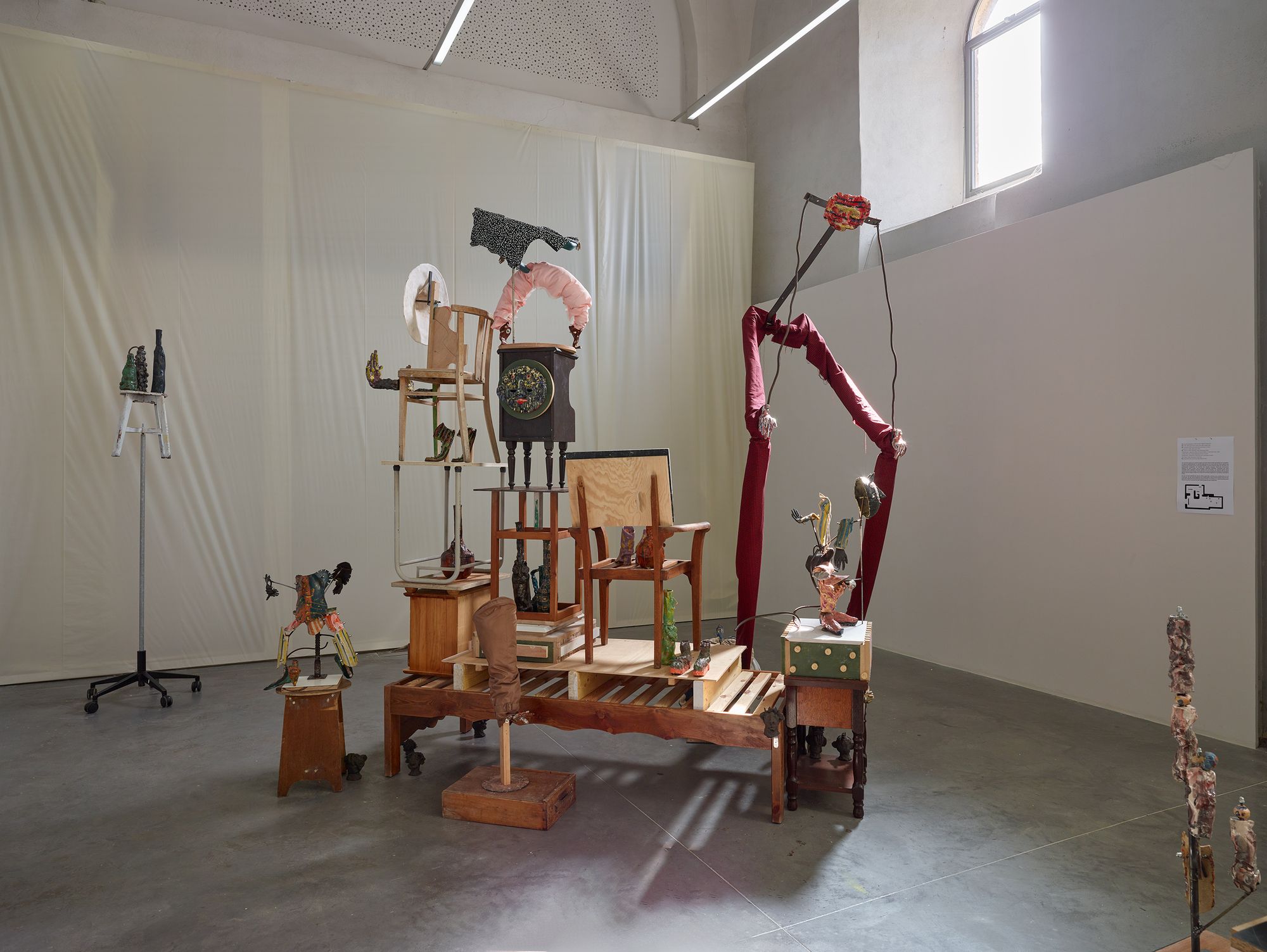
Stepping into the exhibition feels like arriving at a concert that has already started: you weave your way through, looking for familiar faces or the most welcoming group nearby. Several dozen figures greet us. They resemble figurines or giants, puppets or scarecrows, robots or mannequins, yet are precisely none of these. Lanky or attentive, standing alone or in clusters, they might just as easily be in the midst of a carnival as at a general assembly founding a “temporary autonomous zone,”¹ somewhere between Pinocchio and Mad Max².
Many of the figures are dancing: their repertoire ranges from contemporary dance to tap, metal concerts to traditional folk balls, raves to mime… Dance, a form of expression that requires no tools, only the body, constantly reinvented by eras, environments and subcultures, bringing people together and encouraging them to let go. In recent years, David Posth-Kohler has taken dance classes in the tradition of the German choreographer Pina Bausch, who in the 1970s developed Tanztheater (dance theatre), a choreographic language that moves away from technical virtuosity and instead draws on everyday gestures and the unique energies of each dancer. “I am not interested in how people move but what moves them,”³ said Pina Bausch, playing on the English polysemy of “move,” meaning both physical movement and emotion, which French distinguishes between. Each viewer is free to imagine what moves David Posth-Kohler's figures. Faceless and without assigned gender, they seem to exist in several states at once: Schrödinger's dancers⁴, reminiscent of children's antics, saying everything and its opposite and making people laugh: “sitting upright in my bed by the light of an extinguished candle, I was reading a closed book and as I heard a loud silent noise, I went upstairs to go down to the cellar…” Those who are not dancing are watching, listening or playing cards—and cheating, of course. Forty-eight small clay heads, hidden in every corner, complete this portrait gallery: made by children from CP and CM1 classes in Embrun primary schools, where David was in residency in autumn 2025, they form a playful exercise in style, between likeness and the grotesque.
Each personality emerges through hand gestures, but above all through the expressive power of shoes. David Posth-Kohler creates an entire wardrobe of ceramic footwear—ankle or cowboy boots, trainers, ballet flats or slippers—with vividly glazed surfaces, which he then matches to different postures. And it is true that one does not have the same presence in flat, leather, heeled or pointy-toed shoes; so he ensures that his sculptures feel at home in their footwear. He dresses them in found garments, cut and reassembled with a glue gun, then places them on islands of beds, desks, tables and chairs—rafts or barricades of objects found in the streets of Paris or salvaged from the recycling centre in Embrun. The whole installation is staged among sheets of tarpaulin that suggest a circus tent, a theatre curtain, or a painter's worksite. It is a maximalist yet structured assemblage, where the white cube and the autonomy of art are gently unsettled, but one cannot say it is not refreshing. A pleasure in making is evident throughout the ensemble; a joy in formal and technical experimentation, and an underlying principle of generosity that does not shy away from excess.
David Posth-Kohler seeks moments where the wondrous and the unreal break through—those frightening yet formative experiences in childhood while growing up in a family of magicians, where his mother would be cut in three for the purposes of a performance, but also those redemptive moments sought in adulthood through art, love and other intense sensations. He often draws on the “magical realism” of the films of Italian director Alice Rohrwacher, where wonder and the supernatural emerge within everyday life, popular festivals, rural areas, industrial zones and peripheral landscapes. For her, it is the margins, whatever form they might take, that allow us to “relate to utopia” and thereby “invent the future.”⁵ David Posth-Kohler's future seems to be a curious kind of fiesta, where “art is what makes life more interesting than art”⁶ and where one never forgets to move. So I just have to get up from the desk where I am writing this text and go dance a little.
Mathilde Belouali
With thanks to Crystelle Audibert and Sophie Leriverand, teachers at the Cézanne and Pasteur schools in Embrun, and to the pupils of the CP and CE1 classes who took part in the in-school residency; to Alassane Dermé and the Boquel foundry; to Baptiste Audousset; to Myriam Eyermann from the Graoully workshop; and to the Embrun recycling centre in Pralong.
David Posth-Kohler is represented by the gallery Florence Loewy, Paris.
¹ Zone autonome temporaire [Temporary Autonomous Zone] is an essay by Hakim Bey (1991) that develops the idea of ephemeral spaces in which forms of freedom can be experimented with outside structures of power. The author describes these space-times as fleeting micro-societies, inspired by anarchism and pirate imaginaries, which appear and then disappear before they can be brought under control.
² Mad Max is a science fiction film saga created by director George Miller in 1979. Set in a post-apocalyptic desert, it follows a lone survivor roaming the roads of a country gripped by violence.
³ Pina Bausch, What moves me, 2007, online.
⁴ In reference to “Schrödinger's Cat,” a thought experiment developed in the 1930s by physicist Erwin Schrödinger to highlight the paradox of objects whose state cannot be known at all times.
⁵ Alice Rohrwacher, “Le cinéma doit rendre visible l'invisible” [“Cinema must make the invisible visible”], Affaires culturelles, France Culture, 5 December 2023.
⁶ According to the words of artist Robert Filliou, who advocated “the permanent creation of permanent freedom,” in “Robert Filliou dans les collections du Musée,” Dossiers pédagogiques of the Centre Pompidou, online.
- Events related to the exhibition -
Opening: Thursday 9 April at 6pm
A musical and dance performance, inspired by the exhibition, by pupils from the Embrun Municipal School of Music and Dance: Saturday 11 April at 10am
Le marché, a guided tour of the exhibition: Saturday 18 April at 11am
Le goûter, workshop tour for children: Wednesday 22 April from 3pm to 4.30pm
La liseuse, group reading session: Tuesday 5 May from 6pm to 8pm
Le marché, guided tour of the exhibition: Saturday 16 May at 11am
Le conte, tour and readings amongst the artworks, in partnership with Embrun Library: Wednesday 20 May at 3pm